
FOR PARENTS, GUARDIANS, CAREGIVERS
Built for your kid. Designed to earn your trust.Navi is a self-guided mental wellness app for young people - backed by decades of research, built with safeguards for serious concerns, and grounded in real respect for your teen’s privacy.
In the moment support to navigate everyday challenges - and the harder ones too.

Through Navi’s short, self-guided activities, teens build personalized action plans for navigating everyday challenges — from every day stressors like test anxiety to more serious concerns like grief and conflict.
Each interaction is designed to be helpful in the moment. Your teen doesn’t need to log in every day, hit a streak, or share their progress.
Activities are designed so teens choose what to work on and move at their own pace, building genuine confidence and coping skills along the way. This approach is rooted in what behavioral scientists call self-determination theory.
Real change becomes possible when young people feel in control of their own choices, capable of handling what life throws at them, and understood rather than judged. Navi is not a chatbot and is not diagnostic. Navi does not use generative AI.
RISK DETECTION
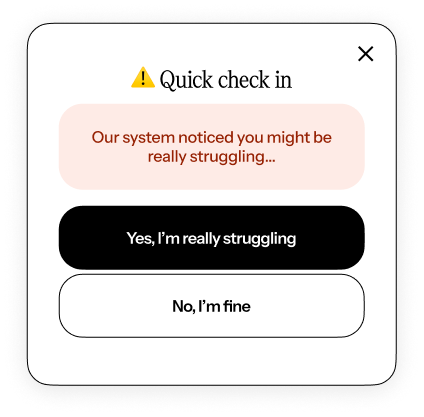
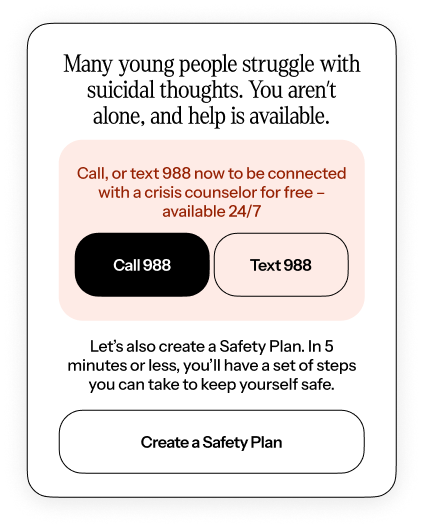
Designed for safety, not surveillance.Navi is programmed to recognize when a user discloses suicidal thoughts. When it does, here is what happens.




PRIVACY
You won't be able to monitor your teen's Navi activity. Here's why that's the right call.Mental wellness support only works when a young person feels safe about being honest. Knowing a parent could read every message or action plan is the fastest way to shut down engagement - the research is clear on that.
What we ask of you is the more useful thing: open communication. Ask you teen if and how they are using Navi. Leave it up to them to share with you, if they want to.






WHY IT WORKS
Decades of research across 100,000 youthNavi was built upon decades of research from the Lab for Scalable Mental Health, directed by our co-founder Dr. Jessica Schleider at Northwestern University.
Dr. Schleider is a clinical child & adolescent psychologist, and an Associate Professor of Medical Social Sciences, Pediatrics, and Psychology at Northwestern University.
The science behind Navi has been shown to be effective in reducing a variety of mental health symptoms — including hopelessness - across more than 100,000 youth.
The questions parents and guardians ask us most often.
-
Navi respects user privacy and does not allow monitoring of individual use on Navi. We believe trust and confidentiality are essential to a young person engaging honestly with mental wellness support.
Parents can engage in open communication with their children about their app usage. We have the highest standards of safeguards in place in case Navi detects risk.
-
Navi was built upon a decade of research from the Lab for Scalable Mental Health, directed by our co-founder Dr. Jessica Schleider at Northwestern University. Dr. Schleider is trained as a clinical child and adolescent psychologist, and is an Associate Professor of Medical Social Sciences, Pediatrics, and Psychology at Northwestern.
The science behind Navi has been shown to be effective in reducing a variety of mental health symptoms — including hopelessness — across more than 100,000 youth.
-
Navi maintains the highest standards of data privacy and security, and prioritizes the safety of young people. Navi does not sell, rent, or share your child’s personal information with third parties for marketing purposes.
Navi implements strict security measures to protect data, and only shares it when required by law or with trusted service providers needed for program functionality. See our full Privacy Policy for more information.
-
We do not use AI to create content, resources, or activities on the Navi platform. Everything is written by our clinical team. Navi users never interact with an AI chat-bot in the app.
We do use Natural Language Processing (a form of AI) to read any open-field text responses submitted by users to scan for risk of suicide. We do not use third-party AI to process the data. This enables us to identify at-risk users faster than if a human were reading every response manually.
Our clinical team has a process in place to verify that all risk situations are being properly identified and escalated.
-
Navi has been programmed to attempt to recognize when users disclose risk for suicide. If suicide risk is detected, that user is provided information to call or text the 988 Suicide & Crisis Lifeline, and prompted to create or review a safety plan.
Important: Navi is not a crisis service. It is a complement to — not a replacement for — professional support. If you believe your child is in immediate danger, call 988 or 911.
Still have questions? Email us at hello@meetnavi.com - we’d love to hear from you.